
Product · Guide
Trace any value back to its machine.
When a number on a dashboard looks wrong, the first question is always "where did this come from?". MaestroHub saves the origin with every value, so the answer is one click away instead of a day in the logs.
Try it
Why is OEE 0.68?
Hover or tap any card to light its path. A demo plant, with illustrative values.
This 0.68 was published at 06:00:01 by line2-oee from three inputs. One of them, quality, is Uncertain: it was read from counter 12 on Filler 2, whose connection is down now.
Read from
Inputs
Pipeline
This value
In the product
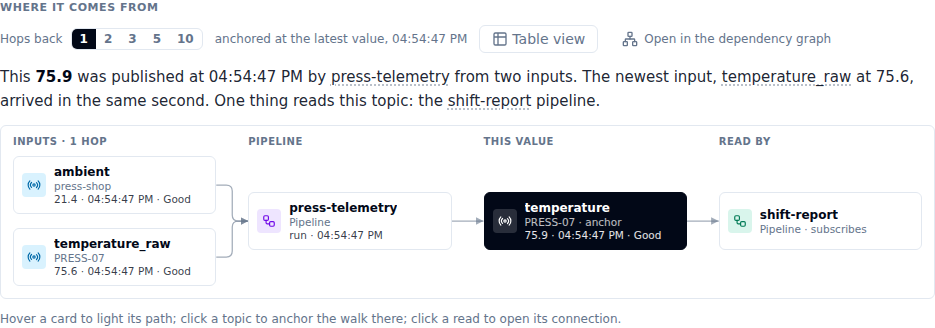
Where it comes from, in Data Explorer: the answer as a sentence, the walk as a map.
Why it holds up
Origin is saved with the value
When a pipeline computes a value it records every input it consumed and stamps that on the record at publish time. Reads stamp the machine address or topic. Nothing is inferred later.
Each value as it was, not as it is
The walk shows every input with the value, time and quality it had at that moment, and it never consults today's configuration. Repoint a tag tomorrow and today's records still name today's source.
Quality can't hide
Every value carries good, uncertain or bad, and a computed value is never better than its worst input. A broken connection shows up red where it sits in the chain.
Alerts explain themselves
When an alert fires, Probable cause walks the record that fired it and ranks the suspects: bad inputs first, then missing ones, then uncertain, then stale. An empty list means the alert is real.
People, apps and agents are named
A value published directly says who published it: a broker client, a person, an API client or an AI agent through MCP, with the person it acts for.
An answer auditors can take away
The same walk as an indented table, with time, quality and who made it on every row, copied as text in one click. A trace link can be shared as it is.
Questions
How do I trace a value on a dashboard back to the machine it came from?
You need the origin stored on the value itself, not looked up from configuration later. MaestroHub stamps every value with where it came from when it is written: the machine address or topic it was read from, the pipeline run that computed it and the inputs it used. Open any value and MaestroHub walks those records back, hop by hop, to the register or topic the data entered from, showing each input as it was at that moment.
What is data provenance in manufacturing?
Provenance is the record of where a value came from and how it was made: which machine, which connector, which calculation, and who or what wrote it. Lineage is the chain you get when you follow provenance from a result back to its sources.
Why is lineage from configuration not enough?
Configuration describes the setup as it is now. If a tag is repointed to another machine, lineage worked out from configuration gives the new source for old values too. Origin stored on each value at write time keeps history true.
How does it help when an alert fires?
The alert's Probable cause walks the lineage of the exact record that fired it and ranks anomalous inputs, bad quality first. Operators see which input is responsible without reading pipeline logs.
Can an AI agent use the walk?
Yes. An AI agent can ask why a value is what it is and get the same chain: the producing pipeline, the inputs as they were and the raw source where the data entered.
What are the limits?
Values written before mid-June 2026 have no origin stamped, so their chain ends early. Long-term archives and rolled-up summaries do not carry provenance. A missing input is shown as unavailable rather than hidden, so you can see when a trace is incomplete.
Walk a value on your own data.
In the six-week pilot you pick a number on your own dashboard and we walk it back to the register it came from, in front of you.