
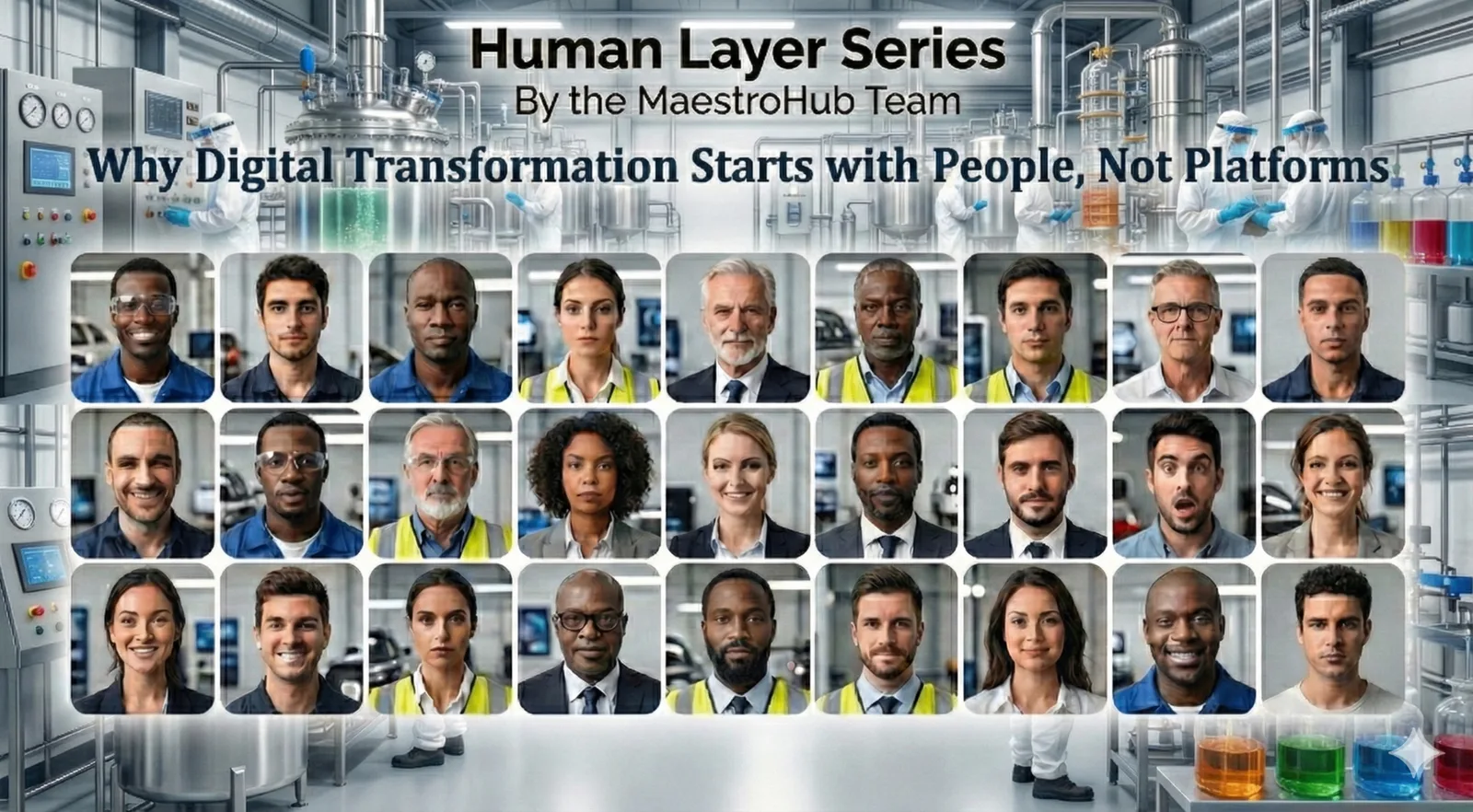
The Hidden Beginning: Why People Are the True Foundation of Digital Transformation
Digital transformation success is defined not by the technology stack or investment size, but by the “Human Layer”, the foundation of trust and shared belief that dictates whether people adapt to change.
Digital transformation has become a central phrase in strategy decks. But beneath the slideware, a simpler factor defines success: the Human Layer, the unspoken network of trust, understanding, and shared belief. This layer determines whether people move together or drift apart.
In manufacturing, this carries more weight. Digital initiatives introduce a new rhythm: data moving faster than conversation, metrics reshaping what “good performance” means. A factory doesn’t simply upgrade; it asks its people to reinterpret what their work means. The technology rollout is the visible story, but the human readiness beneath it decides the ending.
Mindset Over Mechanics: The Difference Between Reluctant and Engaged Teams
The true starting line of transformation is the required mental shift from ‘comfort to curiosity,’ where leaders and frontline staff must clearly understand how new digital tools will make their jobs easier and measure success.
When transformation is discussed, it often sounds mechanical, focused on integration architecture or data pipelines. But every initiative begins with how people perceive the change.
- For Senior Leaders: Transformation requires replacing comfort with curiosity. The CEO must see competitiveness, the CFO must see efficiency, and the COO must see reliability.
- For Production Teams: Transformation feels like disruption to routines. The key question is: Does this make my job easier or harder? If the answer isn’t clear, hesitation sets in.
The organizations that move fastest are not those that push hardest; they are those that prepare minds before they move systems. They explain why change matters, how success will be measured, and what support will exist. This patience creates momentum. The difference between a reluctant team and an engaged one isn’t policy, it’s clarity.
The Anatomy of Hidden Resistance in Manufacturing
Resistance to digital transformation rarely looks like rebellion; it appears as quiet delays and reversion to old habits, often rooted in fatigue from failed past projects, fear of punitive visibility, and the perceived loss of specialized professional identity.
Resistance to change is the invisible tax on progress. It grows every time people feel a change is being done to them rather than with them.
This resistance includes key layers:
- Skepticism/Fatigue: Employees have endured years of “digital initiatives” that promised simplicity but delivered extra work. The emotional ledger often reads negative before a new system arrives.
- Fear of Visibility (Surveillance): While leadership sees dashboards as empowerment, employees may feel they are being subjected to surveillance. When visibility feels punitive, data adoption collapses. When it feels supportive, accountability flourishes.
- Fear of Loss of Professional Identity: Specialists worry that digital systems, like those automating the instincts of the veteran engineer or planner, will replace their expertise. Successful organizations don’t position data as a teacher, but as a student that learns from people before advising them.
Rebuilding trust comes from proof, early, visible, tangible wins. When teams witness a small but genuine success, skepticism begins to thaw.
Trust Through Visibility: How SSoT Aligns Culture
Trust is the invisible infrastructure of transformation; it scales when a Single Source of Truth (SSoT) provides shared context, enabling different departments (Finance, Operations, IT) to interpret the same data with confidence.
Trust breaks because of misalignment. Departments operate with different definitions of truth. The lack of synchronization means no one shares a single, unified picture.
- Alignment is Cultural: When a CFO and a COO can open the same dashboard and interpret the same number with confidence, meetings stop being about reconciling data and start being about solving problems. This moment, when people realize they’re looking at one version of reality, is when trust begins to scale.
Visibility doesn’t mean exposure; it means shared context. Accountability transforms from a rule into a reflex when everyone sees how their actions ripple across the organization. The operator becomes a contributor to the company’s success narrative.
From Control to Confidence: The Modern Leadership Shift
Modern industrial leadership thrives on confidence, the ability to openly share real-time data and empower others to act on it, replacing the outdated model where information was hierarchically controlled and filtered.
Historically, industrial leadership equated control with power, holding information tightly to ensure order. In a connected enterprise, the more information is held, the slower the organization moves.
- Modern Leadership Model: Leaders trade bureaucracy for transparency, using clarity to build alignment. They understand that people make better decisions when they can see what leadership sees. The greatest tool of modern management is clarity, not authority.
The transition from control to confidence is a personal shift for executives. It takes humility to realize that a plant manager might catch an issue before it reaches the boardroom. When this happens, the system proves itself as an extension of leadership, not a threat.
Transformation as a Human Chain: The MaestroHub Philosophy
Transformation succeeds when organizational silos align emotionally and operationally around shared truths, creating a chain reaction where trust between departments leads to consistent investment, scalable experimentation, and a culture of accountability.
When digital transformation succeeds, it’s because people aligned around shared truths. The process is a chain reaction:
| If… | Then… | Resulting in… |
|---|---|---|
| Operations trusts Finance | Data becomes meaningful | Improved ROI tracking |
| Finance trusts IT | Investment becomes consistent | Stable growth |
| IT trusts Innovation | Experimentation becomes possible | Continuous Improvement |
| Innovation trusts Governance | Change becomes sustainable | Reduced risk |
| Governance trusts Operations | Accountability becomes culture | Enterprise learning |
This chain forms the Human Layer, a measurable layer of alignment between people, systems, and shared understanding.
Technology as an Extension of Trust
Digital platforms act as a cultural amplifier: they reinforce trust in a transparent organization or expose its absence in a siloed one. MaestroHub’s philosophy is to connect systems without demanding new workflows, removing friction and honoring existing expertise.
It’s tempting to think digital tools build trust, but they only amplify the culture already in place.
At MaestroHub, the philosophy is: The goal isn’t to replace systems; it’s to connect them in a way that honors existing expertise.
The platform brings together data from machines, MES, ERP, and sensors without demanding new workflows. This removes friction instead of adding it. Transformation is experienced as relief, not disruption:
- CFOs can trace the financial impact of downtime in real time.
- COOs can adjust priorities before bottlenecks emerge.
- ESG teams can verify compliance instantly.
Conclusion: When Humans Stop Guessing
The future of manufacturing will be defined by synchronized minds, not just perfect machines. The strongest indicator of future readiness is Alignment Maturity, the degree to which a company’s people trust the same data, share the same definitions, and believe in the same goals.
Every system, no matter how advanced, still depends on belief:
- Belief that the numbers are right.
- Belief that the information is fair.
- Belief that the organization rewards truth.
Technology cannot manufacture belief, only people can. But once belief takes hold, technology amplifies it.
Digital transformation begins when people stop guessing and start trusting, and when every stakeholder realizes they’re working from the same story. That’s the real promise of the Human Layer, not just smarter factories, but more connected ones.
If your organization is planning its next transformation cycle, start by asking the only question that matters: Do our people trust what they see?
At MaestroHub, we help industrial leaders close that trust gap, not by replacing systems, but by connecting them.
Join us to explore how a unified view of data can become a unified culture of performance.